Introduction
Workers lose 2.8 hours per week searching for misplaced items, which translates to roughly $6,719 USD annually per employee in opportunity cost, according to research on workplace productivity. The root cause isn't just disorganization; it's poor visibility, fragile materials, and rigid designs that can't adapt when workloads change. Most standard organizers move the clutter around rather than solving the underlying workflow problem.
Material, structure, and design determine whether a desk organizer actually changes how people work or just creates another visual obstacle. This guide covers the specific, measurable benefits of mesh desk organizers—productivity, long-term cost, and workspace function—written for procurement teams and bulk buyers.
Key Takeaways
- Open-grid metal structure keeps every stored item immediately visible, eliminating daily search friction
- Steel mesh construction outlasts plastic alternatives by 3–5x, lowering total cost of ownership
- Modular configurations adapt to specific roles and workflows without replacing the system
- Cluttered desks measurably increase stress and emotional exhaustion — organized mesh systems reduce that load at the source
- ISO 9001:2015-certified manufacturing delivers consistent quality across bulk orders of 100–250+ units
What Is a Mesh Desk Organizer?
A mesh desk organizer is a structured desktop storage unit built from welded or woven steel wire. It holds and categorizes everyday supplies—pens, files, trays, mail—within a compact footprint, keeping every stored item visible at a glance.
Typical deployment environments include:
- Individual corporate workstations
- Home offices
- Educational institution desks
- Government and administrative settings
- Shared hot-desk environments where multiple users need to locate items quickly
The core value is functional: how quickly someone can locate an item, use it, and return it without losing focus on the task at hand.
Key Advantages of Mesh Desk Organizers
For bulk buyers outfitting corporate offices, schools, or retail chains, the right organizer isn't just a desk accessory—it's a procurement decision with measurable operational impact. These three advantages explain why mesh consistently outperforms alternatives at scale.
Instant Visibility Reduces Daily Search Time and Mental Friction
The open-grid structure keeps every stored item in direct line of sight, unlike opaque bins or closed drawers where supplies disappear and require active searching to retrieve.
In practice: When a user reaches for a tool, there is no rummaging or drawer-opening. The workspace remains mentally "scannable" throughout the workday, keeping attention on the task rather than on locating supplies.
The productivity case:
Knowledge workers lose 2.8 hours per week searching for needed information and physical items. At average compensation rates of $46.15 per hour, this represents approximately $6,719 per employee annually in lost productivity.
Physical search time compounds on top of digital interruptions. Office workers are interrupted every two minutes—totaling 275 interruptions per day. Eliminating one avoidable interruption source has an outsized impact on focus quality. Research shows it takes 23 minutes to resume an interrupted task, and workers compensate by working faster, increasing stress and time pressure.
KPIs impacted:
- Daily average search time per worker
- Task completion speed
- Focus duration per session
- Interruption frequency
When this matters most: High-traffic desks, document-heavy roles (teachers, managers, administrative staff), and shared workspaces where different users need to locate items without prior knowledge of the system setup.
Structural Durability Delivers Lower Total Cost of Ownership
Metal mesh organizers are built from interwoven steel wire, making them resistant to dents, warping, and the structural collapse that affects plastic organizers under load. The form holds its shape even when holding heavy items like binders, staplers, or stacked files.
Material comparison:
| Material | Elastic Modulus (Stiffness) | Tensile Strength | Typical Application |
|---|---|---|---|
| Low-Carbon Steel (AISI 1008) | 200 GPa | 305-340 MPa | Metal Mesh Organizers |
| Acrylic (PMMA) | 3.14 GPa | 72.0 MPa | Clear Plastic Organizers |
| ABS Plastic | 2.04-2.17 GPa | 34.3-38.6 MPa | Opaque Plastic Organizers |
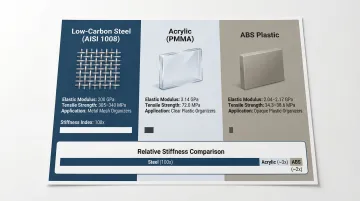
Low-carbon steel is nearly 100 times stiffer than common office plastics, ensuring it resists the cracking, snapping, and deformation that forces premature replacement of acrylic and polystyrene accessories. A powder-coated finish extends this lifespan further—ASTM D2794 and D3359/ISO 2409 standards validate that compliant coatings withstand impacts and adhere without flaking under normal daily use.
The cost math:
Total Cost of Ownership (TCO) accounts for all costs from acquisition to disposal—and the gap favors mesh. A mesh organizer lasting 8–12 years costs less per year than a plastic alternative replaced every 3–5 years.
For organizations outfitting 50–100 desks, the compounding effect of reduced replacement frequency translates to meaningful procurement savings. A plastic organizer lasting 3 years that needs to be replaced more than twice over a decade costs significantly more in total than a mesh organizer lasting 10 years, resulting in meaningful savings per desk annually—compounding further across 50–100 desks over time.
For bulk orders, per-unit cost is only part of the equation. MeshNest's ISO 9001:2015 certification signals documented quality management systems that deliver predictable performance across large production runs—reducing the variance that drives unplanned replacement spend.
KPIs impacted:
- Product replacement rate
- Per-unit cost over time
- Maintenance overhead
- Total procurement spend across budget cycles
When this matters most: High-use environments—corporate offices, educational institutions, government workspaces—where organizers are used daily by multiple people and replacement costs multiply quickly at scale.
Modular Design Supports Flexible, Role-Specific Workspace Configuration
Mesh desk organizers are available in modular configurations—pen caddies, file sorters, paper trays, tiered letter trays—that can be combined, repositioned, or expanded independently, allowing the workspace setup to match specific roles without replacing the whole system.
How modularity works in practice:
- A teacher managing student submissions can pair a multi-slot file sorter with a pen caddy
- A project manager can dedicate one file sorter slot per active client
- A home office worker with limited space can start with a single caddy and add components as workload grows
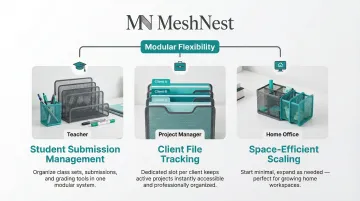
Why modularity has measurable value:
Unlike all-in-one solid organizers with fixed compartments, a modular mesh system adapts when job responsibilities change—no sunk cost in a layout that no longer fits the workflow.
Research by Knight & Haslam (2010) found that empowered office designs—where workers have input into workspace decoration—enhance employee well-being and productivity compared to lean configurations. Providing modular accessories that allow personalization yields measurable benefits.
For organizations, modularity allows standardization of a core unit with role-specific additions—procurement buys a consistent base SKU while departments configure to their own needs. MeshNest's OEM/ODM customization allows bulk buyers to specify compartment configurations, finishes, and dimensions to match exact workspace requirements.
KPIs impacted:
- Setup reconfiguration time
- Employee satisfaction with workspace
- Procurement flexibility
- Per-role functional fit
When this matters most: Environments with varied roles on a single office floor, growing businesses where job functions evolve, and educational institutions serving different teacher or student workflow needs.
What Happens When Desk Organization Is Overlooked
Research by Dao & Ferrari found that office clutter directly predicts higher emotional exhaustion and occupational stress — both statistically significant findings. It also lowers job satisfaction and drives decisional procrastination. These aren't soft outcomes; they show up in measurable productivity loss.
Compounding operational consequences in shared settings:
- Inconsistent desk setups create friction during handovers and shift changes
- Low-quality or mismatched organizers break under daily use, generating repeat replacement costs
- Clutter extends task-start times and degrades focused output quality
- Employees lose an average of 18 minutes daily searching for and setting up desks in hot-desking environments
The reputational consequence in client-facing environments: a visually disorganized workspace signals poor process control regardless of the actual work quality inside. For procurement teams and facilities managers, delaying standardization doesn't just preserve the problem — it compounds it across every desk added to the floor plan.
How to Get the Most Value from a Mesh Desk Organizer
A mesh organizer delivers the most value when it's part of a coordinated system rather than an isolated addition. Pair a pen caddy with a file sorter and a paper tray so every category of supply has a designated visible home — nothing left loose on the desk surface.
The zone-and-assign approach makes this practical:
- Position the organizer within arm's reach of the primary work area
- Assign every item a fixed compartment so it can be returned and located without thought
- Arrange sections by frequency — daily-use items up front, occasional items further back
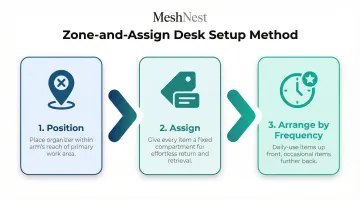
Standardized setups become especially important when outfitting multiple workstations at once. For schools, government offices, and enterprises equipping dozens or hundreds of desks, consistency across workstations reduces confusion and simplifies restocking.
MeshNest's OEM/ODM program lets bulk buyers specify compartment configurations, finishes, and dimensions to match exact workspace requirements. Orders are produced at factory-direct pricing, with ISO 9001:2015, SMETA, and Sedex certifications backing quality consistency across large runs.
Conclusion
Mesh desk organizers deliver three compounding advantages: instant visibility cuts the daily time and cognitive cost of searching for supplies; structural durability reduces long-term procurement spend; and modular design ensures the system adapts to changing roles and workflows without requiring frequent replacement.
These benefits compound over time. Returns are highest when items go back to assigned spots consistently, configurations are reviewed as workloads shift, and the setup is treated as an operational standard — not just a personal preference.
Frequently Asked Questions
Frequently Asked Questions
Are mesh desk organizers worth the money?
Yes. Steel mesh organizers typically last 8–12 years versus 3–5 years for plastic, so the higher upfront cost works out cheaper over time. Daily time saved not hunting for misplaced supplies adds up fast.
What are the benefits of mesh desk organizers?
Steel mesh organizers deliver three practical advantages over plastic alternatives:
- Instant visibility — open-grid construction means you see every item without opening drawers
- Long-term durability — steel wire outlasts plastic by 3–5x under daily office use
- Modular flexibility — add or swap components as your workflow changes without replacing the whole setup
How can I better organize my desk with a mesh desk organizer?
Use the zone-and-assign method: pair complementary components (caddy + file sorter + tray), assign every item a fixed home within the organizer, and keep only active-task items on the desk surface. Position the organizer within arm's reach and arrange compartments by frequency of use.
What are the different types of mesh desk organizers?
Main types include all-in-one caddies for everyday supplies, multi-tiered letter trays for paper management, vertical file and magazine sorters for active project folders, and standalone pen holders. These can be combined or expanded to match specific workflow needs.
What is the best material for a mesh desk organizer?
Powder-coated steel mesh. It outperforms plastic, acrylic, and wood on impact resistance, visibility, and longevity — steel holds its shape under daily use where plastic cracks, warps, or discolors over time.
Why is modularity a useful feature in a mesh desk organizer?
Modularity lets users expand, reconfigure, or replace individual components as their workflow changes—without scrapping the whole system. Organizations can standardize a base unit while letting departments add role-specific pieces, reducing sunk costs when job responsibilities evolve. To explore modular mesh organizer options for bulk procurement, reach MeshNest on WhatsApp at +91 98370 74236 or email hello@themeshnest.com.