
Introduction
We've all been there: mid-task, you dig through a cluttered desk drawer searching for a working pen, only to find tangled chargers, mystery cables, and a drawer that won't close properly. This isn't just frustrating, it's a productivity drain. Research shows that knowledge workers lose up to 2.5 hours daily searching for information, and disorganized desk drawers contribute directly to this lost time.
A well-organized desk drawer supports how you actually work — not just how your workspace looks. This guide covers everything from emptying and categorizing your drawers to choosing the right organizers and building a maintenance habit that sticks.
Key Takeaways
- Empty drawers completely before reorganizing to eliminate overlooked clutter
- Assign each drawer a dedicated function based on frequency of use
- Use physical dividers to create fixed zones that prevent item drift
- Choose metal mesh organizers for durability, easy cleaning, and long-term airflow
- Maintain order with a "one in, one out" rule and a 5-minute weekly tidy-up
How to Organize Your Desk Drawers Step by Step
Step 1: Empty Every Drawer Completely
Pull out all drawer contents and place them on a flat surface. This forces a full audit rather than a partial shuffle, and allows you to measure each drawer's internal dimensions accurately for organizer selection later.
Professional organizing methodologies mandate this "blank slate" approach. The Association of Professional Declutterers and Organisers (APDO) advises completely emptying drawers before beginning the organization process, and the KonMari Method requires taking everything out to provide a fresh view of all contents.
While drawers are empty:
- Wipe them down thoroughly with a soft cloth
- Remove any stuck-on debris or dust
- Consider adding a drawer liner for grip and surface protection
- Measure interior depth, width, and height precisely
Step 2: Sort Items into Functional Categories
Group all items by type before making any decisions about what stays or goes. Common categories include:
- Writing tools (pens, pencils, markers, highlighters)
- Chargers and cables
- Paper products (notepads, sticky notes, envelopes)
- Personal items (lip balm, hand sanitizer, first aid supplies)
- Tech accessories (USB drives, headphones, adapters)
- Office tools (scissors, stapler, tape, paper clips)
- Miscellaneous items

Sorting first reveals duplicates and category imbalances that would otherwise remain invisible when items are scattered. You might discover twelve pens but no scissors, or five charging cables for devices you no longer own.
Step 3: Declutter Ruthlessly
Test every writing utensil and discard dry ones. Recycle mystery cords unused for over a year. Toss broken items, duplicates, and anything that belongs in a different room entirely.
Use this benchmark: If an item hasn't been used at the desk in the past three months and serves no backup function, it doesn't belong in a desk drawer.
A 2024 survey found that the average junk drawer contains 53 items, with 52% of people cleaning their drawer once a year or less. The goal is elimination first, containment second. Better bins won't fix an overcrowded drawer.
Step 4: Measure Drawers and Select Organizers
Before buying any organizers, record the exact interior depth, width, and height of each drawer. Even small measurement errors cause organizers to not fit flush, leaving wasted space or blocking drawer closure.
Why precision matters: Standard office desk drawers don't have universal dimensions. A Steelcase pencil tray requires 6 inches of height clearance, whereas a Herman Miller Meridian pencil drawer has only 2 inches of interior height. What works in one desk may not fit in another.
When selecting organizers, prioritize formats that leave no loose gaps:
- Modular trays — adjustable to fit irregular drawer widths
- Stackable inserts — useful in deeper drawers with vertical clearance
- Interlocking compartments — prevent shifting when the drawer opens and closes
Step 5: Load Drawers and Label Zones
Place items back drawer by drawer, filling organizer compartments by category. Position the most-reached-for items toward the front of the drawer where they're easiest to access.
Add simple labels to organizer compartments—even handwritten ones work. Labels reduce decision fatigue and make it easier for others sharing the space to return items correctly, keeping categories intact over time.
How to Assign Each Drawer a Purpose
The core principle of "drawer zoning" is simple: each drawer should serve one dominant functional category, not be a general catch-all. When every item has a designated home, you stop hunting and start reaching.
Top Drawer = Daily Essentials Only
According to OSHA ergonomic guidelines, frequently used items should stay within the primary work zone — the area swept by your forearm at elbow height. Everything in your top drawer should be reachable without standing up.
Stock with:
- Pens and a notepad
- Charger for active devices
- Sticky notes
- Lip balm or hand sanitizer
- Business cards
Treat this drawer as prime real estate and resist the urge to overfill it. Cramming it with everything "important" defeats the purpose of prioritization and makes retrieval just as slow as an unorganized drawer.
Middle Drawer(s) = Task-Specific Tools
These hold items you reach for a few times a week — not constantly, but often enough to need easy access. Good candidates include:
- Scissors and tape
- Stapler
- USB drives
- Extra notepads
- Calculator
Bottom or Deep Drawer = Bulk Storage
Deep drawers work best for vertically stored items like notebooks or file folders rather than small loose items. Use this space for:
- Backup stationery supplies
- File folders and documents
- Device cables for occasional use
- Personal items used infrequently
Choosing the Right Desk Drawer Organizers
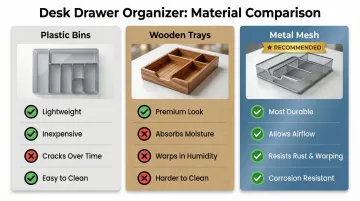
The three most common organizer materials offer distinct tradeoffs:
- Plastic bins — lightweight and inexpensive, but crack and discolor over time; easy to clean but wear down faster than other options
- Wooden trays — warm, premium look, but absorb moisture, warp in humid environments, and are harder to clean
- Metal mesh organizers — most durable long-term; allow airflow to prevent dust buildup underneath, and resist rust and warping. Powder-coated finishes can meet ASTM B117 corrosion resistance standards, making them well-suited for daily-use drawers.
Modular vs. Fixed Organizers
Beyond material, how the organizer fits your drawer matters just as much. Fixed-dimension trays are affordable but may not fit every drawer precisely. Modular or adjustable sets — with expandable sections or variable-width dividers — let you build a custom layout that uses every inch.
Size Matching Matters More Than Aesthetics
A common mistake is choosing organizers that look good in photos but are either too tall for shallow drawers (blocking closure) or too small (leaving items loose alongside the bins). Always verify that the organizer's height is at least 5–10mm shorter than the drawer interior to ensure smooth operation.
MeshNest manufactures metal mesh desk organizers at a vertically integrated facility in Moradabad, India — controlling production from raw wire to powder-coated finish. Their organizers are ISO 9001:2015 certified and available for OEM/ODM customization, making them a practical sourcing option for retailers and distributors stocking workspace organization products.
Common Mistakes to Avoid When Organizing Desk Drawers
Skipping the Declutter Step
Reorganizing without removing unnecessary items creates the same chaos inside better-looking bins. The purge must come before the placement. Professional organizers agree that buying bins before decluttering is one of the most common organizing mistakes.
Ignoring Drawer Dimensions
Purchasing organizers based on appearance rather than exact measurements is one of the most common reasons desk organization fails within days. Items spill out of ill-fitting bins and the system is abandoned quickly.
Overstuffing the Top Drawer
The top drawer works best as a curated, fast-access zone — not a catch-all. Keep it limited to items you reach for every day:
- Pens, a highlighter, and one or two daily tools
- A notepad or sticky notes
- Any small item you need within the first five minutes of sitting down
Anything beyond that belongs in a lower drawer, categorized by frequency of use.
How to Keep Your Desk Drawers Organized Long-Term
Establish a "One In, One Out" Rule
Before adding any new item to a drawer—a new pen set, a charger, a pack of sticky notes—an equivalent item must be removed, donated, or discarded. This strategy creates awareness and prevents the slow accumulation of impulse buys without requiring a full reorganisation.
Schedule a 5-Minute Weekly Drawer Reset
At the end of each work week, take a few minutes to:
- Return items to their correct compartments
- Clear out loose items that migrated in
- Remove anything that doesn't belong in that drawer
The reset itself takes under five minutes — but consistency is what makes it stick. Research shows it takes an average of 66 days for a new behaviour to become automatic, with individual timelines ranging from 18 to 254 days. Two months of weekly resets is usually enough to make it feel effortless.

Reassess the System Every Few Months
Work habits, tools, and needs change. A drawer layout that worked six months ago may no longer match how you actually use your desk. A quarterly check-in to reassign zones or swap organizers keeps the system aligned with real usage.
Frequently Asked Questions
What is the KonMari method for drawers?
The KonMari method applied to drawers involves first discarding items that don't "spark joy" or serve a clear purpose, then storing remaining items vertically (standing upright) within organizer compartments. This prevents items from being buried and forgotten — everything stays visible without digging.
What are some common drawer divider mistakes?
The most frequent errors include buying dividers without measuring the drawer interior first, choosing dividers too tall for shallow drawers (blocking closure), and using too few dividers—which leaves large open zones where small items drift and mix together.
What should I put in the top desk drawer?
The top drawer should hold only the items used daily—typically pens, a notepad, sticky notes, and an active charger. It should never hold more than fits comfortably without digging, because easy reach is what makes the top position worth using.
How do I organize a desk drawer that has too much stuff in it?
Start by emptying the drawer entirely, then apply a strict declutter pass before adding anything back. Most overcrowded drawers hold items from multiple categories that belong elsewhere — the drawer itself is rarely the problem.
Should I use drawer liners when organizing desk drawers?
Drawer liners are optional but useful — they prevent organizers from sliding, protect the surface, and simplify cleaning. Non-slip rubber works best under metal or plastic organizers; adhesive-backed liners suit drawers with a fixed layout. For bulk orders of metal mesh drawer organizers, MeshNest offers factory-direct pricing — contact the team on WhatsApp at +91 98370 74236 to discuss product options.