Introduction
Working from a couch, kitchen table, or bedroom corner means your supplies have nowhere reliable to live. Traditional storage — pen cups, drawer organizers, desktop trays — depends on a fixed surface that stays in place. Without a desk, those systems fall apart fast.
Wall-mounted storage is one alternative, but it comes with real constraints. According to This Old House's guide to hanging hardware, choosing the wrong anchor or ignoring weight ratings is a common reason wall organizers fail — worth knowing before you build your entire system around vertical surfaces.
Organizing without a desk requires a different framework entirely: defined zones, vertical surfaces, and portable containers that move with you. This guide covers each approach, with practical options for every type of deskless setup.
Key Takeaways
- Build your system around four zones (wall, floor, door, mobile) rather than a single surface
- Sort supplies by frequency of use before purchasing any containers
- Vertical and wall-mounted storage does the heavy lifting — treat it as your main storage layer
- Add at least one portable solution if you work from multiple rooms
- Label everything and commit to a weekly 5-minute reset
How to Organize Office Supplies Without a Desk: Step by Step
Step 1: Sort and Categorize All Supplies Before Touching a Single Organizer
Buying organizers before sorting is the fastest route to wasted money and a failed system. Without a desk to spread things across, every storage spot must be deliberate. Start by emptying every drawer, bag, and pile where office supplies currently hide.
Use a dual categorization method:
By Type:
- Writing tools (pens, pencils, markers, highlighters)
- Paper and notepads
- Tech accessories (cables, chargers, USB drives)
- Mailing supplies (tape, scissors, stamps)
- Reference documents (manuals, printouts, notebooks)
By Frequency:
- Daily use: Items you reach for every workday
- Weekly use: Supplies needed occasionally but not daily
- Rarely used: Items kept for specific projects or emergencies
This dual sort determines both container type and placement. Daily-use scissors belong in a wall-mounted caddy at eye level. Rarely-used mailing supplies can go in a closed floor bin.

This step forces a necessary purge. Non-working pens, outdated documents, and duplicate staplers add bulk to a desk-free system where space is at a premium. Be ruthless—if you haven't used it in six months, it doesn't belong in your primary workspace.
Step 2: Map Your Storage Zones Based on Where You Actually Work
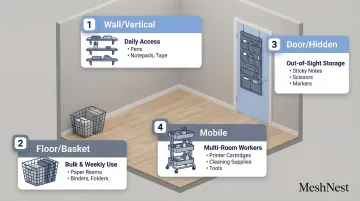
Without a desk, your storage zones are defined by the surfaces and structures near where you work: walls, doors, corners, floors, and the paths you travel between rooms.
Four main zone types:
1. Wall/Vertical Zone (Daily Access)
- Best for: Frequently used supplies that need immediate visibility
- Location: Eye level to shoulder height on the wall nearest your primary work spot
- Examples: Pens, notepads, scissors, charging cables
2. Floor/Basket Zone (Bulk & Weekly Use)
- Best for: Larger items or supplies used less frequently
- Location: Corner floor space, under tables, beside seating areas
- Examples: Paper reams, file folders, reference binders
3. Door/Hidden Zone (Out of Sight Storage)
- Best for: Supplies you want accessible but not visible
- Location: Behind doors, inside closets with over-door organizers
- Examples: Mailing supplies, backup inventory, archived documents
4. Mobile Zone (Multi-Room Workers)
- Best for: Supplies that travel with you between work locations
- Location: Rolling cart or portable caddy that moves between rooms
- Examples: Current project files, daily-use pens, laptop accessories
Before buying anything, sketch your space. Identify which walls have clearance for mounting, which doors can support over-door organizers, and whether you need mobility between rooms. Assign each supply category from Step 1 to one of these zones.
Step 3: Select the Right Organizer Type for Each Zone
Matching the right organizer format to each zone is critical. Desk organizers designed to sit on flat surfaces will tip, slide, or fail when placed on shelves or floors.
Wall Zone Organizers:
- Metal wire/mesh grids: Open visibility, modular, and durable. Metal mesh organizers like those from MeshNest hold their shape without a desk surface underneath, giving you full visual inventory for pens, scissors, and small tools
- Pegboards: Maximum customization with movable hooks; good for heavier items when properly mounted
- Floating shelves with bins: Combines vertical storage with contained organization
Floor Zone Organizers:
- Stackable bins with labels: Clear or mesh construction for visibility
- Magazine holders: Vertical file storage that doesn't require wall mounting
- Large baskets: For bulk paper, packaging materials, or reference books
Door Zone Organizers:
- Over-the-door caddies: Multi-pocket fabric or clear plastic organizers
- Door-mounted file pockets: For documents and papers
- Hook-based systems: For bags, headphones, or lightweight tools
Mobile Zone Organizers:
- Rolling carts: Multi-tier units that move between rooms
- Portable supply caddies: Handled containers for essential daily items
- Laptop bags with organizer pockets: For true mobile workers
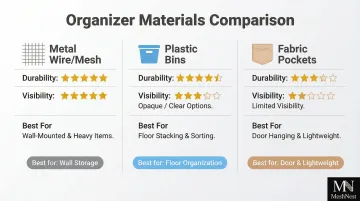
Material Considerations:
| Material | Best For | Durability | Visibility |
|---|---|---|---|
| Metal wire/mesh | Wall-mounted, heavy supplies | Excellent—holds shape without desk support | Full visual inventory |
| Plastic bins | Floor storage, stacking | Good—can crack under heavy weight | Opaque unless clear |
| Fabric pockets | Door organizers, lightweight items | Fair—stretches over time | Limited |
In desk-free setups, metal mesh holds its shape without a surface beneath it, offers instant visual inventory, and carries more weight than fabric or thin plastic. Those three qualities matter most when every storage spot has to work independently.
Step 4: Install, Label, and Build a Reset Routine
Wall Mounting Hardware
Wall-mounted solutions require proper hardware. According to engineering guidelines, safe working loads should be only 25% of an anchor's ultimate test load. A 100-pound rated anchor safely holds just 25 pounds.
Mounting options:
- Stud mounting: Gold standard for heavy loads (pegboards, loaded wire grids). Use a stud finder to locate studs (typically 16 or 24 inches apart)
- Toggle bolts: For drywall without studs; tested to hold 130-180 pounds before failure
- Adhesive hooks: Renter-friendly but limited to 7.5 pounds maximum for heavy-duty hooks—suitable only for lightweight items
Label Every Zone
Because supplies are spread across zones rather than concentrated on one desk, labels prevent the system from collapsing. Label every bin, basket, pocket, and section — a label maker or clear handwritten tags both work.
Build a Weekly Reset
Set a recurring calendar reminder. Once a week, spend five minutes returning items to their assigned zones. Without this habit, even a well-designed system drifts back to clutter.
When Does a Desk-Free Office Organization System Make Sense?
A desk-free organization system fits well in more situations than most people expect. The key is knowing which conditions make it work — and which ones push against it.
Ideal Scenarios:
- Small apartments with no space for a dedicated work surface
- Shared living areas where a permanent desk would take over common space
- Remote workers splitting time between home and other locations
- Rooms that serve multiple purposes throughout the day
- Anyone prioritizing a lean, low-footprint setup over traditional furniture
Less Efficient Scenarios:
- Work that generates large volumes of paper and needs a stable writing surface
- Setups with multiple monitors or bulky equipment requiring a fixed platform
- Homes with young children where wall-mounting isn't a safe option
- Home-based businesses managing inventory well beyond personal supply needs
How Much Stuff Do You Actually Have?
Desk-free systems work best when your supplies stay contained. Once volume grows — separate material sets for multiple clients, product inventory for a side business — the system starts to strain. At that point, supplementing with dedicated furniture makes more sense than reorganizing around its absence.
What to Assess Before Choosing Your Desk-Free Storage Solutions
Space Audit
Before purchasing organizers, measure available wall space, door depth, and floor area in your work zone. Many desk-free solutions have minimum clearance requirements.
Key measurements:
- Wall width and height for grids or pegboards
- Door thickness and clearance for over-door organizers
- Floor corner dimensions for basket or cart placement
- Distance between wall studs (if mounting heavy items)
A few minutes with a tape measure saves you from a frustrating round-trip to the returns counter.
Equipment and Portability Requirements
Do you work from one fixed spot or multiple locations? The answer shapes your entire storage strategy.
Single-location workers can rely on wall-mounted and floor storage. Multi-location workers need at least one mobile solution—rolling cart, supply tote, or portable caddy. A setup built entirely on wall-mounted pieces breaks down the moment you shift rooms.
Portability checklist:
- Do you work from different rooms on different days?
- Do you frequently move between home and other locations?
- Does your work require shifting between a writing area and a computer area?
If you answered yes to any of these, build portability into your system from the start.
Supply Volume and Weight
Wall-mounted and door organizers have strict load limits. Exceeding those limits is how wall organizers fail—and how walls get damaged.
Weight considerations:
- A ream of paper weighs approximately 5 pounds
- Reference books can weigh 2-4 pounds each
- Filled pen caddies weigh 1-3 pounds
- Binders and file folders add up quickly
Before choosing mounting hardware, tally your total supply weight. Then check the organizer's rated load capacity and stay well below it—hardware manufacturers build in tolerances, but real-world loads shift, vibrate, and accumulate over time.
Key Factors That Determine Whether Your Desk-Free Storage System Works
The quality of a desk-free system isn't measured by how many organizers you buy, but by how well four key variables are controlled.
Frequency-of-Use Alignment
Supplies used daily must be in the most accessible zone — wall-mounted at eye level or within arm's reach. Supplies used rarely belong in the least accessible zone: a high shelf or closed bin. Mixing these two categories is the primary reason desk-free systems fail within weeks.
When you have to dig through three bins to find scissors you use daily, you stop using the system. The scissors end up on the nearest flat surface — your kitchen counter, coffee table, or windowsill. Within days, the organized system reverts to scattered clutter.
Proper alignment means the system supports your workflow rather than fighting it. Weekly items stay visible but unobtrusive. Rarely used items disappear until actually needed.
Portability Match
If you work from three different spots but have only fixed wall-mounted storage, you'll constantly carry items back and forth with no designated container. Supplies end up scattered across rooms with no clear home.
Remote workers often shift locations throughout the day — from a focused writing spot to a video call area to a shared workspace. Without a portable organizer, supplies follow this migration in pockets and random bags, undoing the system entirely.
At minimum, multi-location workers need one portable unit: a rolling cart, handled caddy, or organized tote that travels with core supplies between zones.
Wall and Vertical Space Quality
The type of wall determines what mounting options are viable. Drywall, plaster, brick, and rental-restricted walls each have different requirements and weight tolerances.
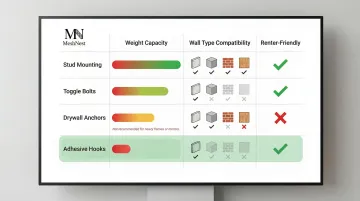
Mounting method comparison:
| Method | Weight Capacity | Wall Type | Renter-Friendly |
|---|---|---|---|
| Stud mounting | Highest (50+ lbs) | Any with wood framing | No (leaves holes) |
| Toggle bolts | High (25–45 lbs safe load) | Drywall, plaster | No (leaves large holes) |
| Drywall anchors | Medium (6–25 lbs) | Drywall only | No (leaves holes) |
| Adhesive hooks | Low (0.5–7.5 lbs) | Smooth surfaces | Yes (removable) |
Choosing the wrong method leads to organizer failure or wall damage. A heavy wire grid on adhesive hooks will eventually peel away. A pegboard mounted only into drywall — not studs — will tear out under repeated use.
Organizer Material and Build Quality
In a desk-free setup, organizers bear more stress than standard desk organizers. They hang, stack, or roll rather than sitting on a stable surface — which means low-quality materials flex, tip, or degrade faster.
Material durability comparison:
- Metal mesh: Structural rigidity, holds shape without desk support, handles weight well, allows full visibility
- Plastic bins: Moderate durability, can crack under heavy weight or temperature changes
- Fabric pockets: Lightweight only, stretches and sags over time with heavier items
Metal mesh organizers provide the rigidity wall-mounted systems require. Open mesh construction allows instant visual inventory, and the material withstands repeated use without flexing or tipping — something plastic and fabric alternatives can't consistently deliver. MeshNest, for example, manufactures wire mesh organizers built specifically for this type of load-bearing use.
Durable organizers that hold their shape require less frequent replacement. A quality metal mesh grid lasts years without sagging. A cheap plastic tray cracks within months — and when it goes, the whole system gets disrupted along with it.
Common Mistakes When Organizing Office Supplies Without a Desk
Using desk organizers on shelves or floors: Desk caddies, desktop trays, and monitor-stand organizers are built for flat, stable surfaces. On shelves, they slide. On floors, they tip. Instead, reach for wall-mounted grids, stackable bins with wide bases, over-door organizers, or rolling carts built for mobility.
Buying containers before sorting supplies: Choosing organizers based on aesthetics — before categorizing what you actually own — leads to wrong sizes and wasted money. An Instagram-worthy wire basket is useless if it's too small for your paper volume.
Ignoring wall space entirely: Without a desk, floor and table space is limited and constantly needed for other uses. Wall-mounted solutions offer the highest capacity for a desk-free setup, yet they're frequently skipped because people avoid assessing mounting requirements.
Setting up a fixed system when you work in multiple spots: An all-wall-mounted setup gets bypassed when you move between rooms or locations. Supplies end up in bags and random piles because nothing is designed to travel with you.
Skipping labels and a return habit: In a multi-zone setup, supplies left "out" have no obvious home without labels. Within days, the system collapses back into clutter — no visual cue to bring items back.
Frequently Asked Questions
What can I use to store office supplies if I don't have a desk?
Wall-mounted organizers (wire grids, pegboards, floating shelves), over-the-door caddies, rolling carts, and portable supply totes are the primary desk alternatives. The best choice depends on whether you work from a fixed spot or move between locations.
How do I organize office supplies in a small space without a desk?
Wall-mounted grids and pegboards use height rather than floor space, keeping your footprint small. A single rolling cart can also replace multiple pieces of storage furniture while staying mobile.
What is the best type of wall-mounted organizer for office supplies?
Pegboards offer maximum customization and handle heavier items well. Wire mesh grids provide open visibility, modular flexibility, and durability — including with heavier supplies. Fabric wall pockets are limited to lightweight items only. For bulk orders of wire mesh wall organizers, you can reach MeshNest on WhatsApp at +91 98370 74236 to discuss options and pricing.
How do I keep office supplies organized when I work from different spots at home?
Use a two-system approach: fixed wall storage for your primary work location, plus a portable supply caddy or rolling cart that travels with you to secondary work areas. This prevents supplies from scattering across multiple rooms.
How do I organize papers and documents without a desk?
Wall-mounted vertical file holders work best — they keep documents visible and accessible without consuming floor space. Over-the-door file pockets and labeled magazine holders on shelves are solid secondary options for overflow.
How often should I reset or tidy a desk-free office supply system?
A 5-minute weekly reset is enough for most setups. Desk-free systems spread supplies across multiple zones, so items migrate faster than on a single surface — brief, regular returns to their assigned spots keep things from unraveling.