Introduction
A cluttered desk doesn't just look unprofessional — it costs time. Workers lose an average of 4.3 hours per week searching for misplaced items, and most standard desk organizers do little to solve the root problem. The materials, visibility, and structure of the organizer matter as much as having one at all.
Most desk organizers claim to reduce clutter. A mesh desk organizer actually delivers on that — through open visibility, structural durability, and a professional finish that holds up across demanding work environments. This article covers the specific advantages: what changes about how people work, what procurement teams should know, and why material design drives real-world results.
Key Takeaways
- Mesh desk organisers use an open-grid metal structure for instant item visibility and accessibility
- Key advantages: immediate visual access, long-term durability, low maintenance, professional aesthetics
- Knowledge workers lose 2.8 hours weekly searching for misplaced items — visible storage cuts that loss directly
- Metal mesh outlasts plastic alternatives by 3-5x while maintaining structural integrity
- Bulk buyers benefit from export-grade manufacturing consistency that lowers long-term procurement costs
What Is a Mesh Desk Organiser?
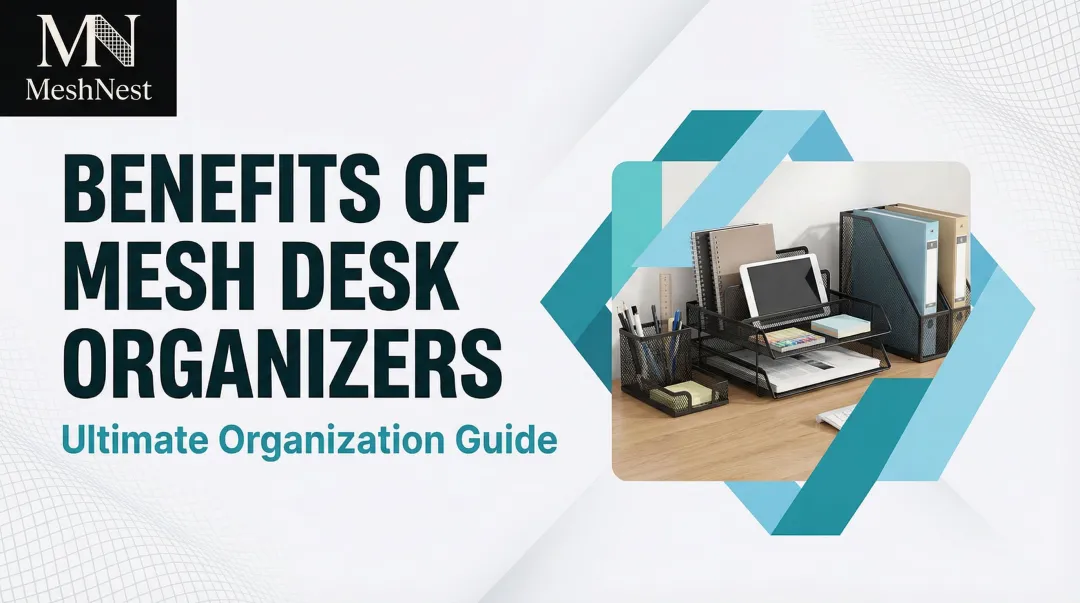
A mesh desk organiser is a structured desktop storage unit constructed from welded or woven metal wire—typically steel—designed to hold and categorise everyday office supplies within a compact footprint. These organisers accommodate pens, files, paper trays, mail, and other desk essentials while consuming minimal surface area.
Common deployment environments:
- Individual workstations in corporate offices
- Home office setups for remote workers
- Educational institutions (teacher desks, student workspaces)
- Government offices and administrative environments
- Hot-desking and shared workspace environments
Across all these settings, the organiser functions as a workflow tool, not a decorative accessory. Its practical value comes down to one thing: how quickly a person can find an item, use it, and put it back without breaking focus.
Key Advantages of a Mesh Desk Organiser
The advantages below reflect measurable, real-world outcomes: less time lost, fewer replacements, and a more consistent professional appearance — across individual desks and entire office floors.
Instant Visibility Reduces Daily Search Time and Mental Friction
The open-grid structure of a mesh organiser keeps every stored item in direct line of sight. Unlike opaque plastic bins or closed drawers where items disappear and require searching, every pen, clip, or note is identifiable in a single glance.
How this works in practice:
When a user reaches for a tool, there's no rummaging, no drawer opening, no interruption to cognitive flow. The workspace remains mentally "scannable" throughout the workday, allowing workers to maintain focus on their primary tasks rather than diverting attention to locate supplies.
Why this matters:
APQC benchmarking data reveals that knowledge workers lose an average of 2.8 hours per week looking for or requesting needed information. In a standard 40-hour workweek, this represents 7% of payroll time lost to search friction. When multiplied across teams or entire organisations, the productivity cost compounds significantly.
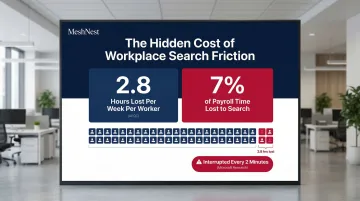
Reduced search friction keeps people in deep work longer — Microsoft Work Trend Index data shows employees are interrupted every 2 minutes by meetings, emails, or chats. Adding physical search time on top of that further erodes the focus needed for quality output.
KPIs impacted:
- Time-on-task and focus duration
- Daily interruptions and average search time per session
- Task completion speed and output quality
When this advantage matters most:
High-traffic desks, roles involving frequent document retrieval (teachers, managers, administrative staff), and multi-user setups where different people need to locate items quickly without prior knowledge of the system.
Structural Durability Delivers Better Long-Term Cost Efficiency
Metal mesh organisers are built from interwoven steel wire, making them resistant to dents, warping, and the structural collapse that commonly affects plastic organisers under load. The form holds its shape even when holding heavy items like binders, staplers, or stacked files.
A powder-coated or rust-resistant finish extends the product's functional lifespan by protecting the surface from corrosion, chipping, and daily-use wear. The unit looks and functions like new far longer than acrylic or bamboo alternatives.
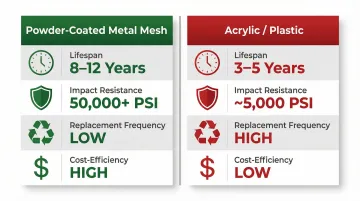
Independent lab tests show that stainless steel can withstand over 50,000 impacts, whereas acrylic begins showing cracks at around 5,000 impacts. Metal fixtures offer an estimated lifespan of 8 to 12 years, compared to just 3 to 5 years for acrylic alternatives.
For organisations outfitting multiple workstations, that durability means measurably lower spend per unit over time. The gap between purchase price and total cost of ownership can exceed 200% across a 15-year lifecycle. Quality commercial accessories typically deliver 12 to 20 years of service, while budget alternatives require replacement within 5 to 8 years.
MeshNest's ISO 9001:2015 certification signals consistent quality management systems across production runs—critical for bulk buyers who need predictable performance across hundreds or thousands of units.
| Material Type | Estimated Lifespan | Impact Resistance | Replacement Frequency |
|---|---|---|---|
| Powder-Coated Metal | 8-12 years | >50,000 impacts | Low |
| Acrylic/Plastic | 3-5 years | ~5,000 impacts | High |
KPIs impacted:
- Product replacement rate and per-unit cost over time
- Maintenance overhead and procurement consistency for multi-unit buyers
- Total cost of ownership across budget cycles
When this advantage matters most:
High-use environments — corporate offices, educational institutions, government workspaces — where organisers are used daily by multiple people and replacement costs compound quickly at scale.
A Clean, Professional Aesthetic That Scales Across Workspaces
The industrial-modern look of metal mesh organisers creates a visually consistent environment across an office floor. Where mismatched plastic containers or ageing wooden trays fragment a desk's appearance, a uniform mesh set gives each workstation a deliberate, finished look — one that holds up under client scrutiny.
The open mesh structure keeps the desk feeling airy and uncluttered even when fully loaded — no visual "heaviness" of solid-sided containers. The neutral metal finish (black, silver, or powder-coated tones) complements any desk colour or office style without clashing.
Research demonstrates that visually appealing environments enhance employee mood and assist in stress management, acting as positive stimuli to support mental health. Conversely, environments with uncontrolled visual clutter are linked to negative attitudinal responses that affect both environmental and job satisfaction.
For businesses and institutions outfitting many desks, a uniform mesh organiser system creates visual consistency across the office floor, reinforcing brand culture and operational standards. In client-facing environments, that consistency is a low-effort signal of operational discipline — the kind of detail procurement managers and facilities teams can standardise once and maintain at scale.
KPIs impacted:
- Employee satisfaction and workspace perception scores
- Client-facing presentation quality
- Brand environment consistency and professional image
When this advantage matters most:
Offices receiving clients or visitors, co-working environments, educational institutions with shared student or teacher desks, and corporate floors where workspace uniformity reflects operational standards.
What Happens When Desk Organisation Is Overlooked
An unorganised desk quietly drains productivity in ways that rarely get measured. Items go missing, workflows stall, and workers spend mental energy tracking where things are instead of doing the actual work. Over time, this becomes a normalised inefficiency — and it compounds.
Practical consequences:
- Inconsistent setups across shared desks create friction during handovers and shift changes
- Low-quality or mismatched organisers break under daily use, generating repeat replacement costs
- Clutter extends task-start times and degrades the quality of focused work
- In client-facing or institutional settings, a disorganised desk signals poor process control — regardless of the underlying work quality
Research by Dao & Ferrari found that office clutter positively predicts emotional exhaustion and stress. As office clutter increases by one unit, emotional exhaustion increases by 0.39 units and stress increases by 0.41 units. Office clutter also significantly negatively predicts job satisfaction.
Studies also link workspace clutter to increased decisional procrastination. This indecision delays task initiation and adds to physical stress over time. The longer desk organisation is treated as low-priority, the harder it becomes to retrofit a functional system — particularly for offices managing dozens of workstations.
How to Get the Most Value from a Mesh Desk Organiser
A mesh desk organiser works best when treated as part of a system rather than a standalone item. Pair a pen caddy with a file sorter and a paper tray so every category of item has a designated, visible home—no item needs to sit unused on the desk surface.
Position the organiser within the primary arm-reach zone so frequently used items are always accessible without shifting posture. Reserve the desk surface itself for the active task only — this reduces visual noise and keeps the work area clear for focused attention.
A few habits make the setup stick:
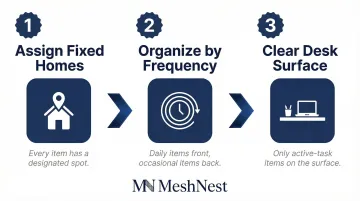
- Assign every item a fixed home within the organiser so it can be returned and found without thought
- Organise compartments by frequency of use — daily items in the most accessible sections, occasional items further back
- Keep only active-task items on the desk surface; everything else belongs in the organiser or storage
For organisations rolling this out across multiple locations, consistency matters as much as the setup itself. MeshNest's OEM/ODM customisation allows bulk buyers to specify compartment configurations, finishes, and dimensions to match exact workspace requirements — so offices, schools, and government workstations all get a standardised setup built to the same spec, at factory-direct pricing.
Conclusion
A mesh desk organizer delivers on three fronts simultaneously: immediate visibility of every item, durability that holds up under daily use, and a consistent aesthetic that scales across desks without extra effort.
These aren't one-time gains — they compound over consistent use:
- For individual users: less time searching, more time in productive flow
- For organizations: lower replacement costs, higher employee satisfaction, and a workspace that projects professionalism to clients and leadership alike
Few workspace upgrades deliver this return with this little ongoing maintenance. For buyers sourcing at scale, that combination of durability and visual consistency makes the mesh desk organizer one of the most defensible SKUs to stock.
Frequently Asked Questions
What are the benefits of a mesh desk organizer?
The three core benefits are instant visibility of stored items through the open-grid design, long-term structural durability from steel construction that resists bending and wear, and a clean professional aesthetic that keeps the desk feeling organized without visual clutter.
Are desk organizers worth the money?
A quality metal mesh organizer is a long-term investment. Its lifespan (8-12 years) and daily time savings from reduced item-searching outweigh the upfront cost, especially compared to plastic alternatives that require replacement every 3-5 years.
What are the characteristics of a good quality desk organizer?
Look for durable material (steel mesh over plastic), a stable base with non-slip feet, adequate compartment variety for different item types, and a rust-resistant powder-coated finish that holds up over years of daily use.
What is the best material for a desk organizer?
Metal mesh (steel wire) is the best all-round material for most workspaces. It outperforms plastic, wood, and acrylic alternatives on strength, visibility, low maintenance, and longevity.
What is the most efficient way to organize your desk?
Use a zone-based approach: keep only daily-use items on the desk surface, and use a mesh organizer to hold frequently-needed supplies within arm's reach. Assign every item a fixed spot so you always know where to return it and where to find it. For bulk orders of metal mesh organizers, contact MeshNest on WhatsApp at +91 98370 74236 to discuss product options and pricing.